
If camera settings feel overwhelming, you’re not alone.
There’s often a moment when you arrive somewhere new, camera in hand, and everything feels right.
The light is soft, the scene has depth, and you can already imagine the photo you want to take.
But when you look at the result, something doesn’t quite match.
It might be slightly blurred, a little darker than expected, or lacking the clarity you thought you’d captured.
It’s a familiar experience, and more often than not, it comes down to not quite knowing how your camera is responding to the scene in front of you, or not being creative enough with your composition choices.
When Conditions Change, So Should Your Settings
One of the most common challenges isn’t understanding what each setting does in isolation, but recognising how they need to shift depending on where you are. As light changes, so should your settings, but more than that, learning how to harness it to enhance your photographs will allow you to make better creative decisions that result in more impactful photos.

Let’s chat scenes:
The Scene: A bright coastal morning
You’re walking along the coastline just after sunrise. The light is soft, but already strong enough to illuminate the scene clearly. You raise your camera, frame the image, and press the shutter.
The result is sharp, clean, and balanced.
In moments like this, your camera often has enough light to work with, which makes everything feel easier. You don’t need to think too much about adjustments, and it’s a great opportunity to observe how your camera behaves when conditions are ideal.
What you may notice are things like movement, maybe you want to blur the crashing waves, or incorporate some foreground subjects like sparkling sand, or greenery?


OLYMPUS DIGITAL CAMERA
The Scene: A quiet street in the late afternoon
Later in the day, you find yourself wandering through a shaded street. The light is more subtle now, filtered between buildings, shifting constantly as you move.
You take a photo, and it’s slightly darker than expected. You adjust, try again, and notice how small changes begin to affect the outcome.
These are the moments where settings start to feel less predictable, and where understanding how your camera responds becomes more important.
If you’re working with shadows and contrasting light, you’ll need to watch your exposure compensation settings, and ISO, shutter speed also plays a key role here. A quick fix can be to use aperture mode, and increase or decrease your exposure compensation to suit, essentially, you don’t want to overexpose the bright areas, but you don’t want it all dark and moody either (unless that’s the result you’re seeking!).


The Scene: An indoor market or low-light scene
Inside a market or café, the atmosphere changes again. The light is softer, more uneven, and sometimes quite dim. You lift your camera and notice that your images begin to blur or lose a little clarity.
This is often where frustration sets in, not because the scene isn’t interesting, but because it becomes harder to translate what you’re seeing into a photograph.
In lower light, any movement becomes harder to photograph, and auto mode will only get you so far, particularly if you want to be creative with the movement.
One tip – never be afraid of increasing your ISO. There are ‘rules’ out there that say never increase above ISO 800, but depending on your camera, you should be fine to increase in low-light settings up to 1600 without any noticeable noise, even higher!


Why It Starts to Feel Overwhelming
It’s not usually a lack of ability, it’s the speed at which scenes change, and the surrounding environment that can lead to the feeling of ‘oh, this is beautiful, I’m stuck with how to capture it or what settings to use’.
It’s the moment where:
- the light changes
- the scene becomes more complex
- and your camera starts making decisions you don’t fully understand
That’s when the process can begin to feel uncertain.

A Different Way to Approach It
Rather than trying to memorise settings, it can be more helpful to begin by noticing what’s happening in the scene.
Is there enough light?
Is anything moving?
Do you want everything sharp, or just a single detail?
This way of working becomes much easier when you can recognise how your settings respond in different situations.
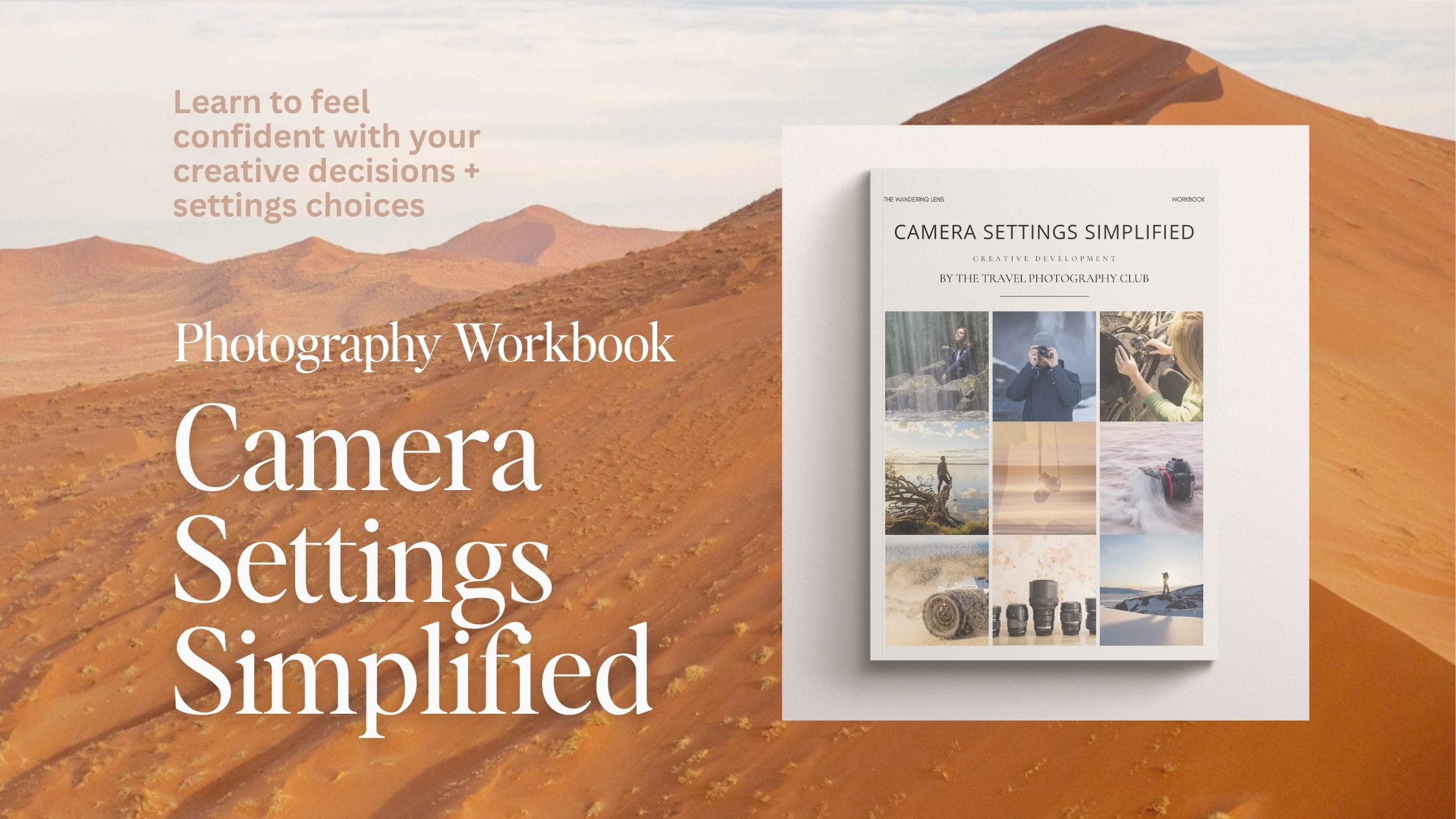
If you’re looking for a more guided approach, the Camera Settings Simplified workbook explores this in more detail.
Understanding your camera isn’t about getting everything right every time. It’s about recognising patterns, noticing how your images respond to different conditions, and gradually building confidence in your decisions.
Over time, what once felt confusing starts to feel more intuitive and you can enjoy the process of being out and about with your camera, exploring creatively and capturing images you’re proud of.
Travel and landscape photographer from Australia who is far more comfortable in a pair of flippers than heels! Having worked for publications such as Lonely Planet, Wanderlust and the Sunday Times, Lisa founded The Wandering Lens to share destination guides to the worlds most photogenic places and outdoor experiences.


Leave a Comment